
If someone had told Little Apprentice Chef Mel, 20 years ago, that the ingredient I’d
spend the most time talking about in my life would be salt, I'd throw some over my
shoulder and ward you off.
And yet — here we are. Two decades later.
Still in love with cooking. Still obsessed with flavour.
And still talking about salt. Every. Damn. Day.
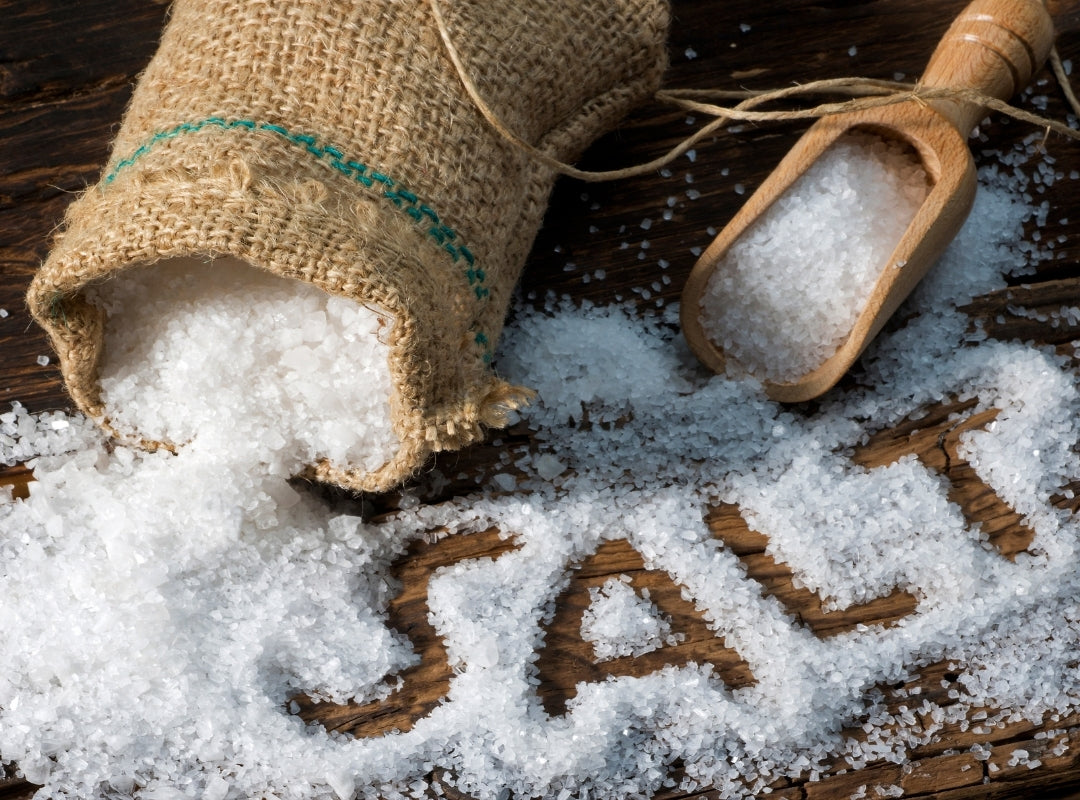
Because salt is everything.
It’s the most underrated, misunderstood, and misused ingredient in your entire
kitchen.
It's the difference between a dish that you just eat and accept, and one that makes
your eyes roll back in your head because it’s so delicious.
Yes, we need salt for our bodies — sodium helps fire our nerves, contract our
muscles, and keep our cells hydrated. If you’ve got a headache, cramps, low
energy? Have some salt. A good one. Celtic, Bajra, Himalayan pink, which are all
salts you’ll find in my kitchen. But 99% of the time, it’s Himalayan pink I’m reaching
for.
Why? Because it works. It’s clean, it’s mineral-rich, and it doesn’t taste like
chemicals.
Let’s talk about that cheap iodised table salt for a sec — you know the one we all
had on the dinner table growing up. Pure white, dry, harsh, and a weird bitterness at
the back of your tongue if you use even slightly too much? That stuff is chemically
bleached, stripped down, and then re-fortified with iodine in a lab. It's been so
processed it barely qualifies as salt anymore.
It’s the salt version of white bread — mass-produced, nutritionally void, and designed
for shelf life, not flavour.
The salts mentioned above, on the other hand, are real. Naturally harvested, they
haven’t been bleached or stripped, and they contain trace minerals like magnesium,
calcium, and potassium — not because they were added, but because that’s what
happens when you scrape them straight from ancient rock beds.
And more than all that science-y stuff, it just tastes better.
Pink salt, in particular, has this gentle saltiness, almost sweet in comparison to
regular table salt. It dissolves beautifully, isn’t too wet to use easily, and it brings out
flavour without ever being aggressive or metallic.
That’s why it’s in everything I make.
But I’m not here to give you a science lecture on electrolytes, I’m here to talk about
salt in food.
In flavour.
In the way it transforms ingredients into meals and meals into memories.
Salt = Seasoning = Flavour
When anyone in the industry says, “Hey, chef, can you try this? They get back:
“Have you seasoned it?”
What we really mean is:
“There is no point in me trying that unless you’ve got salt in there.”
Nine times out of ten, when a dish tastes flat, it’s not because the recipe is wrong or
the ingredients are bad — it’s because you didn’t season it properly.
Salt doesn’t just make food salty. That’s a rookie mistake, too much salt is a problem,
but no salt is a tragedy.
Salt makes food taste more like itself.
It draws out flavour. It enhances sweetness. It balances bitterness. It intensifies
umami. It’s like a volume knob for your dish, it doesn’t change the song, it just makes
it louder and better.
Want to really understand salt?

Try this: make cauliflower soup.
1. Boil up some cauliflower and cream. Nothing fancy. Then taste it.
At this stage, it will taste like hot cauliflower water. Beige. Dull. Like an unfinished
sentence.
2. Now start adding salt, just a pinch at a time. Stir, taste, pause. Add another pinch.
Taste again.
You will literally feel the moment the flavour switches on. The cauliflower becomes
cauliflower. The cream gets creamier. The texture feels fuller. Everything clicks.
That’s what salt does.
The same goes for a creamy mushroom sauce that I use as a good example to start
understanding cooking and seasoning:
1. Cook the mushrooms in butter until they’re browned and caramelised. (Not
soggy. Not grey. Brown.)
2. Add garlic next. After the colour is built, not before. Burnt garlic turns bitter
and salt brings out flavours, so we don’t want to be bringing out bitterness.
3. Pour in your cream and scrape the pan to lift those golden mushroom bits.
The colour you’ve added to the mushrooms is going to add colour to the
cream.
4. REDUCE! This means to cook it down until it thickens.
5. Then — and only then — add salt and taste.
You’ll watch that sauce transform from thin and bland to rich, layered, and addictively
good.
If you don’t hit that flavour explosion? You haven’t added enough salt. If it tastes
salty? You went too far, add a dash more cream. (And yes, learning the line is part of
becoming a good cook.)
For me? I know I’ve hit the perfect point when I get a slight tingle right on the tip of
my tongue. That’s the line where food stops being food and starts being
unforgettable. When I'm tasting, I close my eyes and wonder, can this thing get any
more flavour? You’ll eventually start to know, and if you think it can, and you'll know
that by the either under or overwhelming feeling it gives you, add a little more salt.
Why Chefs Season at the End
This one’s crucial.
You can always add more salt. But you can’t take it out.
So we season at the end. Always.
Why? Because when you reduce a sauce or a soup, you're concentrating
everything. The water evaporates, and what’s left behind gets more intense: sugar,
acid, aromatics, and yes — salt.
If you seasoned at the beginning, you’re concentrating that salt too, and suddenly
your soup tastes like a salt lick.
I was making goulash with my neighbour the other day, and she asked why I hadn’t
salted it yet.
“Mate, this see you next choosdy is about to cook out for 2 hours, no way!” I think I
may have said.
“Do you know how much water is going to evaporate? Do you know how much salt
you’re adding to make sure it’s not salty when it’s done? ALWAYS season at the
end!”
“ok.” She replied …. quite an underwhelming answer to my passion haha
So I wait. I always wait. I add the salt when the dish is ready, not a moment sooner.
That’s how you stay in control. And I NEVER serve a dish that hasn’t been
seasoned.
If you’ve ever ordered our soups or chowders and followed the instructions to finish
cooking them — and the flavours exploded in your mouth — that’s not by accident.
That’s because I’ve deliberately underseasoned them.
Why? Because these are some of the riskiest dishes I sell.
Once they leave my kitchen, I can’t control how far you cook them down. And
seasoning too early, without knowing how much you’ll reduce it, risks turning
something beautiful into a salty mess.
So I season them just enough to allow room for you to follow the final steps —
reducing it slightly, tasting, adjusting. If you do that, you’ll hit that magical point where
the flavour pops.
If you’ve ever tried one and thought it tasted a little flat, try this:
Cook it down just a little more or add a small pinch of salt — stir, taste, and watch
what happens.
When it’s right, it’ll go from “nice” to “holy shit” in one spoonful.
Cooking Is Art. Seasoning Is Science.
Recipes are suggestions. Baking is science. But cooking? Cooking is adjustment.
You taste. You trust. You adapt.
Every tomato is different. Every batch of stock is different. Every brand of salt has a
different grain size and salinity. So we taste. Before and after.
We add a little, stir, let it melt. We taste again. And we keep going until the flavours
start singing.
That’s the real secret. That’s the thing most home cooks miss. They follow recipes.
But great food doesn’t come from recipes. It comes from palate. From intuition. From
practice. From salt.
Salt isn’t just an ingredient. It’s the most important one.
It’s not about making things salty. It’s about making food sing.
It’s the line between dinner and disappointment, between bland and brilliant.
So use the good stuff. Season with intention. Taste as you go.
And never underestimate what a pinch of salt can do.
Until next time,
Mel
(Still salty at my neighbour)
Share:
Inside Mel's Brain: Why is it that food isn’t food anymore?
Mel’s Brain: Would you eat that much if…?